
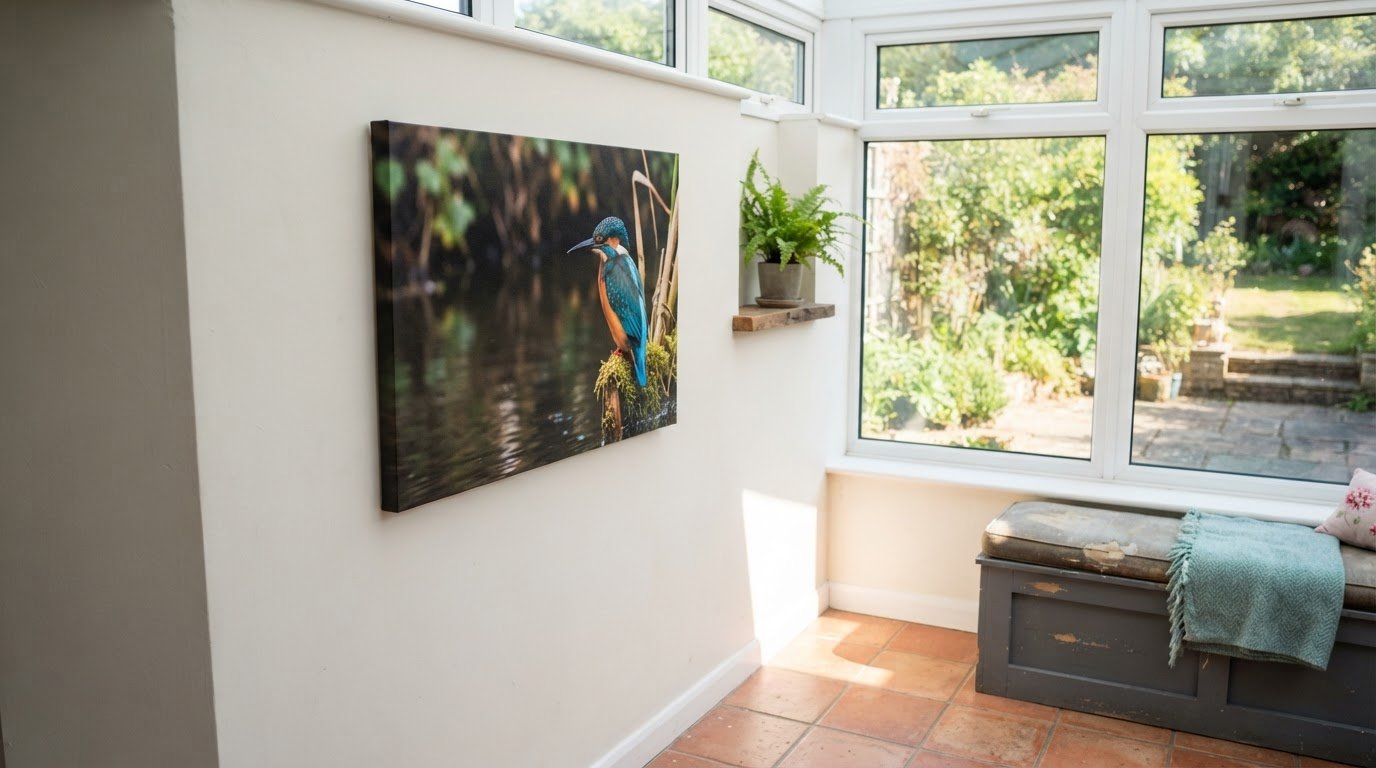
A heavier canvas won’t keep colours bright on its own. Fade-resistant canvas art depends more on print quality and the inks used, though strong sunlight can still affect colour over time. Canvas weight matters too, but mainly for the feel and structure of the finished piece.
It makes sense to want a print that keeps its colour and character in your home. The right materials can help, but “fade-resistant” doesn’t mean the colour can never change. Where you hang the artwork also matters.
Here’s how canvas weight, print quality and fade- and UV-resistant pigments contribute to lasting colour. You’ll also learn what to consider when choosing a canvas print for an indoor space, so you can find artwork that suits both your wall and the room.
Key Takeaways
- Choose canvas for the look and structure you want; weight alone doesn’t determine how long print colours last.
- Look for clear information about ink and print quality to help assess how well colours may hold over time.
- Place indoor canvas away from strong sunlight and heat to help protect its appearance.
- UV-resistant coatings can help limit fading in direct sunlight, but they don’t make placement irrelevant.
Canvas weight and printing quality
Canvas weight affects how a print feels and handles, but it doesn’t determine whether its colours will stay bright. A heavier material may feel more substantial, while lasting colour also depends on the print process, pigments and display conditions. Think of the canvas and the printed image as two parts of the finished piece.
A rolled canvas option can use a poly-cotton blend with a gloss finish. The blend describes the material, while the finish affects its surface appearance. A gallery-wrapped canvas can have the image extending around its sides, giving the artwork a finished edge. Its construction gives the artwork a finished edge without a separate frame. These differences matter when you’re choosing a format for a particular wall.
Print quality shows in the details. Look for clean edges, even colour and well-defined features, especially in photographs or artwork with fine lines. A detailed city scene relies on crisp definition to keep small elements distinct. Smooth colour changes in a landscape also depend on even tone reproduction. Canvas texture can affect how details appear, so the same image may look different on canvas than on a smooth surface.
For example, the listed green forest canvas wall art measures 50.8 × 101.6 cm. Its wide format suits a panoramic scene, where consistent detail across the image matters. Consider both the artwork’s proportions and the wall space before choosing a size.
To clean printed canvas art, gently remove dust with a soft, dry cloth, using light strokes. Avoid soaking the surface or applying household cleaners, which can affect the print and canvas.
Choose fade-resistant canvas art by looking beyond weight: consider the material, finish, construction and visible print detail together. A sturdy canvas can support a quality image, but it cannot compensate for poor printing or placement.
Fade-resistant inks and long-lasting canvas prints
Ink choice affects how well printed colour withstands light, while the room’s conditions influence its exposure. Check the print details and plan its position together.
Fade-resistant inks and materials
Some rolled canvas prints use fade-resistant inks and are described as water-resistant, anti-fade and anti-yellowing. They may also be described as using UL Certified ink. These terms refer to stated ink and surface qualities, but don’t mean colours can never change. Compare the material and ink details provided for each print. Cost and warranty terms also vary by seller and product.
UV-resistant coating effectiveness
A UV-resistant coating can help prevent fading in direct sunlight. For example, outdoor canvas artwork is treated with a UV-protected coating for this purpose. It adds a layer of protection, but doesn’t remove the effect of prolonged light exposure. For an indoor print near a bright window, consider both the coating information and the amount of direct sun reaching the wall.
Indoor print lifespan
There isn’t one reliable lifespan for every fade-resistant canvas print indoors. Ink, print materials, light exposure and room conditions all affect how its colour changes over time. A print displayed away from direct sun faces different conditions from one beside a bright window. “Fade-resistant” signals an intended benefit, not a specific lifespan or warranty. Look for clear product details before choosing.
Sunlight, humidity and heat effects
Direct sunlight can gradually affect printed colour, which is why UV-protected coatings are used to help prevent fading. Heat can also affect canvas: excessive warmth may contribute to warping over time. Humidity can influence the canvas and its support, so avoid placing a print where damp conditions persist. Keep artwork away from strong sun, radiators and fireplaces, and dust it gently with a soft, dry cloth. For a fresh wall display, browse canvas print designs.
Indoor use
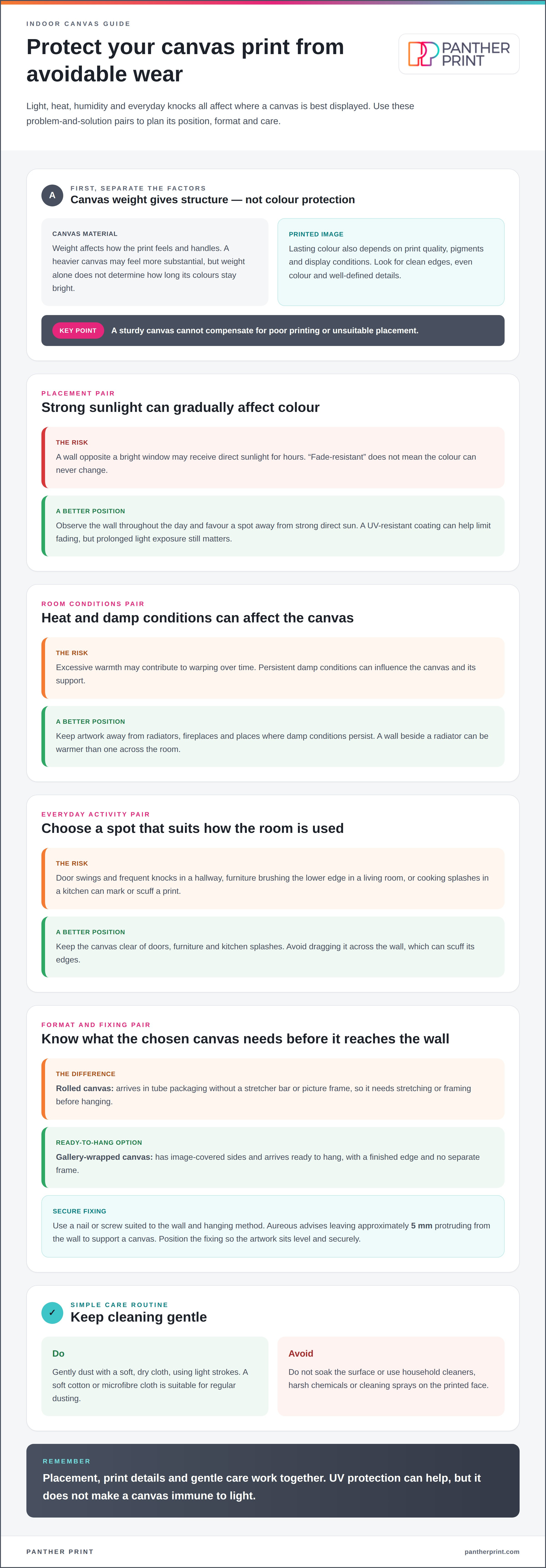
Where a canvas hangs affects its exposure to light, warmth and everyday activity. Choose a position that suits the room and keeps the print away from avoidable sources of wear.
Start by observing the wall throughout the day. A spot opposite a bright window may receive direct sunlight for hours, while a shaded wall has less direct exposure. Avoid hanging canvas artwork directly above radiators, fireplaces or other heat sources, as excessive heat may cause it to warp over time. A wall beside a radiator can also become warmer than one across the room.
Next, match the print format to your plans for hanging it. A rolled canvas arrives in tube packaging without a stretcher bar or picture frame, so it needs stretching or framing before it can be hung. Gallery-wrapped canvas has image-covered sides and arrives ready to hang. The format affects what you need to do before the artwork reaches the wall, so account for that when choosing.
For a secure display, use a nail or screw suited to the wall and the hanging method. Aureous advises leaving approximately 5 mm of the nail or screw protruding from the wall to support a canvas. Position the fixing to keep the artwork level, then check that it sits securely before letting go. Avoid dragging the canvas across the wall, which can scuff its edges.
Room use matters too. In a busy hallway, choose a spot away from door swings and frequent knocks. In a living room, keep the print clear of furniture that might brush its lower edge. In a kitchen, position artwork away from cooking splashes, the hob and the sink. These choices help keep the surface clean and the canvas in good shape.
For regular care, gently dust the surface with a soft cotton or microfibre cloth. Avoid harsh chemicals and keep cleaning sprays away from the printed face. A considered position, secure fixing and light dusting make indoor display simpler.
Are UV-resistant coatings effective on canvas prints?
Yes. A UV-resistant coating can help reduce fading caused by direct sunlight, making it a useful protective layer for canvas prints. Outdoor canvas artwork, for example, is treated with a UV-protected coating to help prevent fading in direct sun. The word “help” matters: a coating supports colour protection, but doesn’t mean the artwork is immune to light.
Think of UV protection as one part of a practical plan. It works alongside the print’s pigments and the position you choose. A canvas displayed in a bright window still receives prolonged light exposure; placing it on a less sunny wall can reduce that exposure. This matters especially for artwork with broad, vivid areas of colour, where gradual changes may be easier to notice.
Protection claims can refer to different features. “UV-protected” usually describes a coating intended to help guard against ultraviolet light, while “fade-resistant” may describe the pigments or finished print. These terms aren’t interchangeable. Check whether the product information names a coating, fade-resistant pigments, or both. That gives you a clearer picture of what helps protect the image.
For indoor use, decide where the print will hang before choosing one. A wall that receives direct sun for much of the day has different exposure from a shaded hallway. Panther Print’s prints use fade- and UV-resistant pigments, but it’s still sensible to keep artwork out of direct sunlight where possible. No protective feature makes placement irrelevant.
Pair the protection with gentle care: dust the canvas with a soft, dry cloth and keep cleaning sprays away from its printed face. Those steps help look after the surface without adding moisture or chemicals. To find a print that suits your room, explore canvas print designs and consider both its finish and display position.
NAN Wind London canvas print is available in three sizes. Outdoor artwork and prints include brackets and hooks that can be used to screw them into a variety of wall types.
Panther Print
Panther Print helps you turn the ideas in this guide into a canvas choice that suits your home. Browse a wide range of artwork, from abstract designs and wildlife to children’s prints and Banksy-inspired imagery. Use what you’ve learned about light, coatings and display position to decide where your chosen print will hang and what details matter for that room.
Whether you’re refreshing a living room wall or choosing artwork for a child’s bedroom, explore themes that bring the space to life. A well-chosen image should feel right in the room and suit the look you want to create. Keep placement in mind, particularly if the wall receives direct sunlight.
Ready to find a canvas print for your space? Contact Panther Print to discuss your choice.
Choose artwork that feels at home
The best print isn’t just one that suits your wall. It’s one you’ll enjoy seeing in your home every day. Let the room’s character guide your choice, whether you want a bold focal point, a peaceful scene or a playful touch for a child’s space.
Explore abstract designs, wildlife imagery and art for kids and nurseries to find a style that feels personal. Panther Print brings these choices together, making it easier to browse artwork that reflects your taste and the atmosphere you want to create. Keep fade-resistant canvas art in mind as you choose, then let the image lead the way.
Ready to take the next step? Contact Panther Print about canvas art and explore a print that makes your space feel more like yours.
Frequently Asked Questions
What makes canvas art fade resistant?
Fade- and UV-resistant pigments can help printed colours withstand light exposure. For fade-resistant canvas art, the pigments, canvas surface and display conditions all play a part. No material makes a print immune to every source of fading. A print on a wall that receives direct sun all afternoon, for example, faces different exposure from one displayed in a shaded room.
Which canvas materials and inks resist fading best?
Look for canvas described as archival-grade and pigments identified as fade- or UV-resistant. These details indicate what the print is made with, rather than promising that colour will never change. Panther Print’s prints use premium archival-grade canvas and fade- and UV-resistant pigments. When comparing print descriptions, focus on named material and pigment features instead of relying on canvas thickness alone.
What is the difference between pigment and dye inks for canvas prints?
Pigment inks use tiny colour particles, while dye inks use colourants dissolved in liquid. Pigments are generally chosen for their resistance to light-related fading; dye inks can produce bright, vivid colour but may be more vulnerable to light. The result also depends on the full print process and display conditions. Check the product details for the ink type rather than assuming every canvas uses the same one.